
Lifestyle

Why Americans Are Moving to Spain: What My US Clients Actually Tell Me

Natasha Horner

Natasha

18 min read

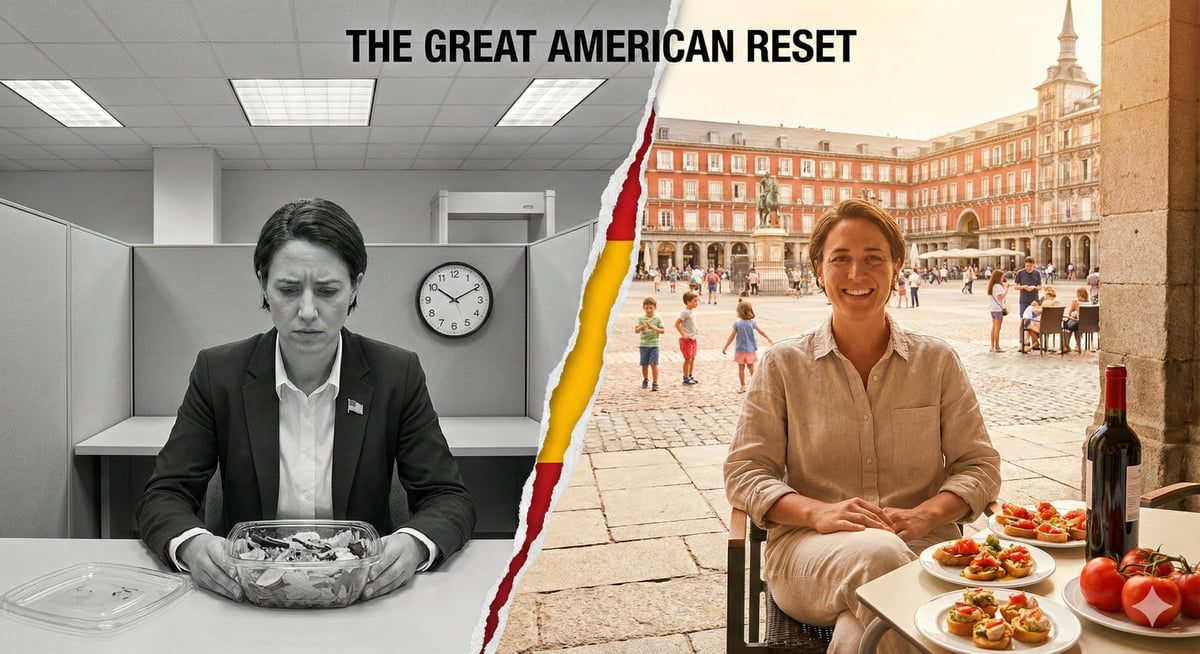
Split image comparing woman in gray office with pizza to woman dining at outdoor European plaza

For years, you could probably sum up the stereotypical Spain relocation dream with: sunshine, sangria and retirement. Not anymore.

I work with a growing number of Americans planning moves to Spain, and the conversations I'm having are often much deeper than "I'd like to live near the beach."

They're talking about quality of life, healthcare, raising children, safety, cost, work-life balance, politics and social climate, walkability, community, retirement and — increasingly — simply wanting life to feel a little less relentless.

So instead of guessing why Americans are interested in Spain, I listen to what my American clients actually tell me.

And the recurring theme is this: they don't necessarily hate America. Many of them are simply questioning whether the life they're working incredibly hard to maintain is still the life they actually want.

So, why Spain?

1. "I want to feel safer in everyday life"

This is probably one of the most emotional conversations I have with American families. Particularly parents.

Some talk about active-shooter drills at school, gun violence, worrying when their children are out, feeling hyper-aware in public spaces, and wanting a different environment for their family.

I'm very careful here because Spain is not crime-free. Obviously. We have theft, burglary, assault, scams and pickpocketing — and there are places where you absolutely need to keep your wits about you. Barcelona would like a word about your unattended mobile phone.

But the nature of the safety concerns many Americans describe is different. Spain's firearms environment is much more tightly regulated than that of the United States, and gun ownership is subject to licensing and controls.

So when a mother tells me "I just want school to feel like school," I understand why that becomes part of the relocation decision. That doesn't mean Spain is some magical bubble where nothing bad ever happens. It means some families feel the risk profile of everyday life is different enough to matter to them. And that's a perfectly legitimate reason to consider moving.

2. "I don't want healthcare to dominate my financial planning"

This one comes up constantly. American clients ask me about Spanish private health insurance and then brace themselves for a number resembling a second mortgage.

The exact premium depends on things like age, provider, medical history, policy, cover and family size — so please don't build a budget around a random figure you saw somebody quote online.

But the structure and pricing of healthcare in Spain can feel very different to Americans accustomed to the US system.

For some Spanish residence routes, private medical insurance is actually part of the immigration requirements. For example, Non-Lucrative Visa applicants generally need qualifying Spanish-authorised health insurance covering risks comparable with Spain's public system, without ordinary copayments, deductibles or coverage limits.

And here is one thing I definitely want to correct from the old article: simply becoming resident in Spain does not automatically give every American access to free Spanish public healthcare. Your entitlement depends on your circumstances, which can include employment, Spanish Social Security contributions, dependent status, pension arrangements, particular residence circumstances and other entitlement routes.

So: "Move to Spain and healthcare is free." No. But: "Spain offers a fundamentally different healthcare environment and private insurance may be considerably more accessible than many Americans expect." Yes.

3. "I want my money to buy me more life"

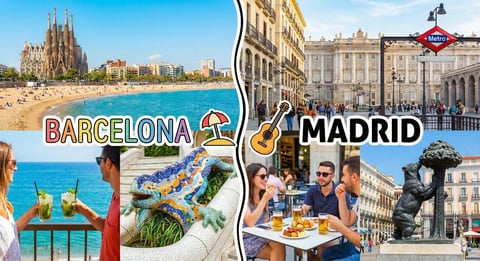
This needs nuance because Spain is not universally cheap anymore. Madrid? Expensive. Barcelona? Expensive. Marbella? Please sit down before opening Idealista.

But depending on where somebody is moving from in the US, their Spanish budget can still produce a dramatically different lifestyle. American movers may find lower housing costs in some Spanish areas, lower restaurant prices, lower private health-insurance costs, less dependence on a car, cheaper everyday socialising and different higher-education costs.

But don't confuse Spain with cheap Spain. Your experience in Jaén is not your experience in central Madrid. Your experience in Murcia is not Ibiza. Someone relocating from San Francisco may find Spanish housing astonishingly reasonable. Someone relocating from a low-cost area of the Midwest might not.

The useful question is: "What will my actual Spanish life cost compared with my current American life?" That's something worth calculating properly.

4. "University doesn't have to mean enormous debt"

This one gets the attention of American parents very quickly. Public university tuition in Spain operates very differently from the US system.

Spain's latest published public-university figures show an average first-enrolment undergraduate credit price of about €15.37 for the 2024/25 academic year, although prices vary by Autonomous Community and subject. Multiply that by a typical 60-credit academic year and you're looking at a very different headline figure from many US universities.

But there are some massive caveats. Fees can vary according to region, university, degree, whether it's public or private, student status, repeat enrolment and nationality/residency rules in certain circumstances. Private and international universities can be much more expensive. So the old "university costs €1,500 to €2,000 a year" was too simplistic.

But the larger point survives: Spanish public higher education can be dramatically less expensive than many American families are accustomed to planning for. And for parents staring down years of potential college costs, that's significant.

5. "I want my children to have more independence"

This is another thing American parents tell me. Not every family. Not every town. But many notice that children are much more visible in public life in Spain. They're in plazas, cafés, parks, restaurants, town centres and family events — often much later in the evening than an American newcomer initially expects.

Spain has a very family-centred social culture. Children aren't expected to disappear from public spaces because adults have gone out for dinner. They come too. That can feel incredibly refreshing for families arriving from a culture where parents sometimes feel they spend their entire existence driving, organising, supervising and driving again.

Does that mean every seven-year-old in Spain is wandering the streets alone at midnight? Obviously not. But the rhythm of family life can feel noticeably different.

6. "I don't want every journey to involve getting into a car"

Now this depends massively on where you live. Please do not buy a finca 14 kilometres outside a village and then email me: "Tash said Spain was walkable." No. Some Spanish areas are extremely car-dependent.

But choose the right city, town or neighbourhood and daily life can be much more walkable than many American suburbs. You may be able to reach supermarket, pharmacy, cafés, restaurants, school, doctors, train and shops on foot. Spain also has extensive high-speed rail connecting many of its major cities.

So living without spending hours every week sitting behind a steering wheel is entirely possible in the right location. For some Americans, that's a huge quality-of-life upgrade.

7. "I want a different relationship with work"

This is a difficult one to quantify. But I hear it constantly. American clients talk about the grind. Long hours. Limited holiday. Always being available. Feeling as though productivity has somehow become a personality trait.

Spain certainly isn't a permanent siesta. People work hard here. People get stressed here. People complain about their jobs here. We're not all sitting outside at 2pm drinking Rioja and congratulating ourselves on having invented leisure. But social life, meals, family and time outside the workplace can feel culturally more prominent. That matters to people asking: "Is this really how I want to spend the next 20 years?"

8. "I want life to happen outside the house"

This is one of my favourite differences. Spain is very externally social. People live in plazas, terraces, cafés, parks, promenades and neighbourhood bars. You see grandparents, teenagers, small children, couples and groups of friends. Everybody occupies the same public space.

And because so much socialising happens outside people's homes, you don't always need a formal invitation to somebody's house before you feel part of something. You can just go out. That can be incredibly valuable for people relocating alone.

9. "I want more community"

Now let's not romanticise Spain into a Disney village where the butcher gives you relationship advice and every neighbour brings soup when you're ill. Some neighbours are lovely. Some are complete pains in the arse. Spain has both.

But the structure of daily life can create more opportunities for repeated human contact. You go to the same café, the same bakery, the same pharmacy, the same market. You start recognising people. They start recognising you. Over time, those tiny connections build a sense that you actually live somewhere, rather than simply occupy a property there. For American clients who describe feeling isolated in highly suburban or car-dependent environments, that can be enormously attractive.

10. "Food feels simpler"

I want to rescue the good point from the original article without making ridiculous health claims.

Spain does have a strong food culture built around fresh produce, fish, meat, legumes, olive oil, bread, seasonal ingredients and eating socially. There are also biscuits, sweets, ultra-processed food, fast food, frozen pizza and enough jamón to sodium-bomb an elephant.

Spain is not a health retreat. And no, moving here will not automatically heal your gut or make you lose 15lbs while eating bread. Would be nice. But many American movers do tell me they enjoy shopping, cooking and eating differently here.

Part of that may be food. Part may simply be that they walk more, eat differently, eat smaller portions, spend more time outside and change routines. That's a far more credible explanation than claiming Spanish tomatoes possess medicinal powers. Although they are bloody good tomatoes.

11. "I want lunch to be lunch"

This deserves its own section because I am completely on board.

The Spanish menú del día remains one of life's small joys. Depending on the town and restaurant, you'll often find a fixed-price lunch offering courses and sometimes bread, a drink or dessert. Prices have risen significantly, particularly in major cities, so the old claim that you'll universally get three courses and wine for €12 is optimistic.

But the cultural point remains. Lunch can actually involve sitting down, eating and talking — rather than chewing something sadly over a laptop while answering Slack messages. Revolutionary.

12. "I want my children to grow up internationally"

For American families, this can be enormous. Moving to Spain can expose children to Spanish, potentially a regional co-official language, European culture, international classmates, different educational environments and easier travel throughout Europe. And children very often acquire languages astonishingly quickly compared with adults. Annoyingly. You'll be celebrating successfully ordering dos cafés while your ten-year-old is correcting your pronunciation.

If you're moving with children, however, research schooling carefully. Education is regional and the language of instruction can vary significantly. Catalunya is not Andalucía. Valencia is not Madrid. This is exactly why choosing the right area matters before signing a property contract.

13. "I want Europe on my doorstep"

This is genuinely one of the great advantages. From Spain you can travel relatively easily to Portugal, France, Italy, Morocco, UK, Germany, Netherlands and the rest of Europe — often within a few hours.

And internally, Spain itself is enormous. You could spend years exploring Andalucía, Galicia, Asturias, Basque Country, Castilla y León, Valencia, Catalunya, Balearics and Canaries without ever leaving the country. For Americans accustomed to huge travel distances, having that much variety relatively close together can feel extraordinary.

14. "I want somewhere where being LGBTQ+ feels legally protected"

This is another reason some of my American clients specifically mention.

Spain legalised same-sex marriage in 2005, with the same legal requirements and effects as opposite-sex marriage. Spain also has national legislation establishing protections against discrimination for LGBTQ+ people and regulating rights relating to trans people.

That doesn't mean homophobia doesn't exist in Spain. It does. Transphobia exists. Discrimination exists. And somebody's personal experience will vary enormously. So I would not use the original "nobody blinks." That's impossible to promise.

But Spain does have a substantial legal framework protecting LGBTQ+ rights, and that can absolutely factor into someone's decision about where they want to build their life. For a deeper look at LGBTQ+ communities, legal protections and the best areas to consider, see our guide to moving to Spain as LGBTQ+.

15. "I can work remotely and actually live somewhere I love"

Spain's Digital Nomad Visa changed the conversation considerably for Americans who don't need a Spanish employer. It provides a residence route for qualifying non-EU remote workers working primarily for companies or clients outside Spain.

Employees must work for companies located outside Spain, while qualifying self-employed applicants can carry out limited Spanish professional activity up to 20% of their total professional work.

That opened Spain to an entirely different group. Not retired, and not looking for a Spanish job — but "I already have an income. Why exactly am I sitting in Ohio when I could be doing this from Valencia?" Fair question. For income requirements, employee vs self-employed rules and how to apply, see our full guide to the Spain Digital Nomad Visa.

Obviously there are tax, Social Security and immigration implications. You cannot simply arrive with your MacBook and declare yourself European. But there is now a genuine route worth exploring.

16. "Retirement doesn't have to look like Florida"

American retirees are another major group I speak to. Spain offers a very different retirement proposition: walkable towns, Mediterranean climate in many regions, healthcare options, European travel, outdoor lifestyle, food culture, beaches or mountains, and a huge variety of property markets.

The Non-Lucrative Visa is often relevant for non-EU retirees and financially independent people who don't need to work from Spain. But there is no universal "Spain retirement visa." And the NLV has specific financial, insurance and other requirements. So retire to Spain? Absolutely possible for many Americans. Turn up because you bought a house? Different conversation.

17. "I want property without spending $1 million"

This one depends enormously on where you're coming from and where you're going. The original article said "€300,000 gets you a villa with a pool." Sometimes it does. Sometimes €300,000 gets you an apartment. And in certain parts of Spain it gets you considerably less.

Spain's housing market has risen substantially, particularly in highly desirable coastal areas, islands, major cities and international hotspots. But the country still has enormous regional price differences. Move away from Marbella, Madrid centre, Barcelona, Ibiza and prime Mallorca, and your budget can look completely different.

The mistake is assuming Spain = cheap property. Instead: Spain = a huge property market containing both very expensive and remarkably affordable places. Our guide to buying property in Spain covers taxes, surveys and legal checks, while the cheapest places to buy guide looks at where your budget actually goes further.

18. "I want somewhere rural"

Yes. Spain has enormous rural areas and thousands of inexpensive properties away from the major cities and coasts.

But let's delete the original fantasy where you buy a €50,000 finca, drill a well, throw up solar panels and live happily off-grid. Spanish rural planning law is not a Pinterest board.

You need to investigate planning classification, legal status of buildings, access, electricity, water rights, wells, septic systems, environmental restrictions, permitted works and land use. And the rules vary regionally. You can absolutely build a more rural, self-sufficient life in Spain. But cheap finca does not equal do-whatever-the-hell-you-want land. Please get legal and technical checks before buying.

19. "I want less car pollution and more pedestrian space"

This one needs correcting too. Spain does not universally have cleaner air than American cities. Air quality varies enormously. Madrid and Barcelona have their own pollution problems.

What Spain has been doing is increasing the use of Low Emission Zones, or Zonas de Bajas Emisiones. Spanish law requires them in municipalities over 50,000 inhabitants, island territories and some municipalities over 20,000 where pollution thresholds are exceeded, although implementation varies by location.

Many Spanish cities have also invested heavily in pedestrianisation, public transport, cycle infrastructure and reduced city-centre traffic. So the better point is not "Spain has clean air." It is: "many Spanish cities make it possible to build a daily life that relies less heavily on driving." For some Americans, that's transformational.

20. "I just want a reset"

Ultimately, this is the one that sits underneath nearly everything else. People rarely relocate across an ocean because they want cheaper tomatoes. They're looking for a different life. Some American clients come to me saying: "Nothing terrible has happened. I just don't want to keep doing this for another twenty years." And I think that's actually one of the most understandable reasons to move.

Spain isn't perfect. Let me repeat that because relocation content on the internet desperately needs to hear it: SPAIN IS NOT PERFECT.

It has bureaucracy, taxes, housing shortages, low salaries, political arguments, frustrating administration, brutally hot summers in some regions, expensive property markets, unemployment, regional tensions and restaurants inexplicably closed on the exact day you need them.

You are not swapping Bad America for Perfect Spain. You're choosing between two different sets of advantages, disadvantages and compromises. The question is whether the Spanish version fits you better.

Can Americans actually move to Spain?

Yes. But Americans don't have automatic freedom of movement in Spain. For stays beyond the normal Schengen short-stay allowance, you'll generally need an appropriate residence route.

Depending on your situation, that might include:

  • Digital Nomad Visa — for qualifying remote workers.
  • Non-Lucrative Visa — often used by retirees and financially independent people who won't be working from Spain.
  • Work-related residence — where the appropriate employment or professional route applies.
  • Study routes — for qualifying education in Spain.
  • Family-based routes — depending on your relationship to an EU/Spanish citizen or another resident.

Your immigration route needs to fit what you're actually going to be doing in Spain. Not whichever visa had the nicest TikTok.

Do Americans pay tax in Spain?

This is the other part nobody should discover after moving. Possibly, yes.

If you become Spanish tax resident, Spain will generally consider taxation of worldwide income, subject to the Spain-US tax treaty and the relevant tax rules.

And being American adds another layer because US citizens generally continue to have US federal tax filing obligations even while living abroad. That doesn't necessarily mean paying full tax twice. But it can mean two systems, two sets of rules and considerably more interesting conversations with accountants.

So any American planning a permanent move should get proper cross-border tax advice before relocating. Not once Hacienda already knows where you live.

So why are Americans moving to Spain?

There isn't one reason. For some: healthcare. For others: safety. Or their children. Or retirement. Or politics. Or work-life balance. Or cost. Or simply: "I went to Spain and realised I wanted my normal Tuesday to feel more like that."

And honestly, that last one is probably more powerful than people realise. Because relocation isn't really about creating one permanent holiday. It's about choosing where you want to do Monday mornings, supermarket runs, dentist appointments, school runs, work, laundry. Life.

If you'd rather do your ordinary life in Spain? Then maybe it's worth investigating properly.

American and Thinking About Moving to Spain?

This is where I would not recommend spending six months collecting contradictory information from Facebook groups. Your move needs to work as one plan. Residency. Tax. Healthcare. Property. Location. Schools if you have children. Pets. Timescale. Money. All of it affects everything else.

My Clarity & Strategy Session is designed to look at the complete picture and help you understand what needs to happen, in what order and where you need specialist professional advice. And if you're still at the "I know I want Spain, but WHERE in Spain?" stage, my Area Analysis service can help you narrow the country down based on the life you actually want and the budget you actually have.

Important

This article discusses general reasons some American clients give for relocating to Spain. Individual experiences vary considerably. Immigration, healthcare, tax, education and property rules depend on individual circumstances and may change, so obtain current professional advice where appropriate.

Natasha Horner

Natasha

Relocation coach helping women move to Spain with clarity and confidence.

Keep Reading

More real talk and practical advice from The Clarity Library.

Browse All Articles