
City Comparison

Madrid vs Barcelona: Which Is Better to Live In?

Natasha Horner

Natasha

15 min read

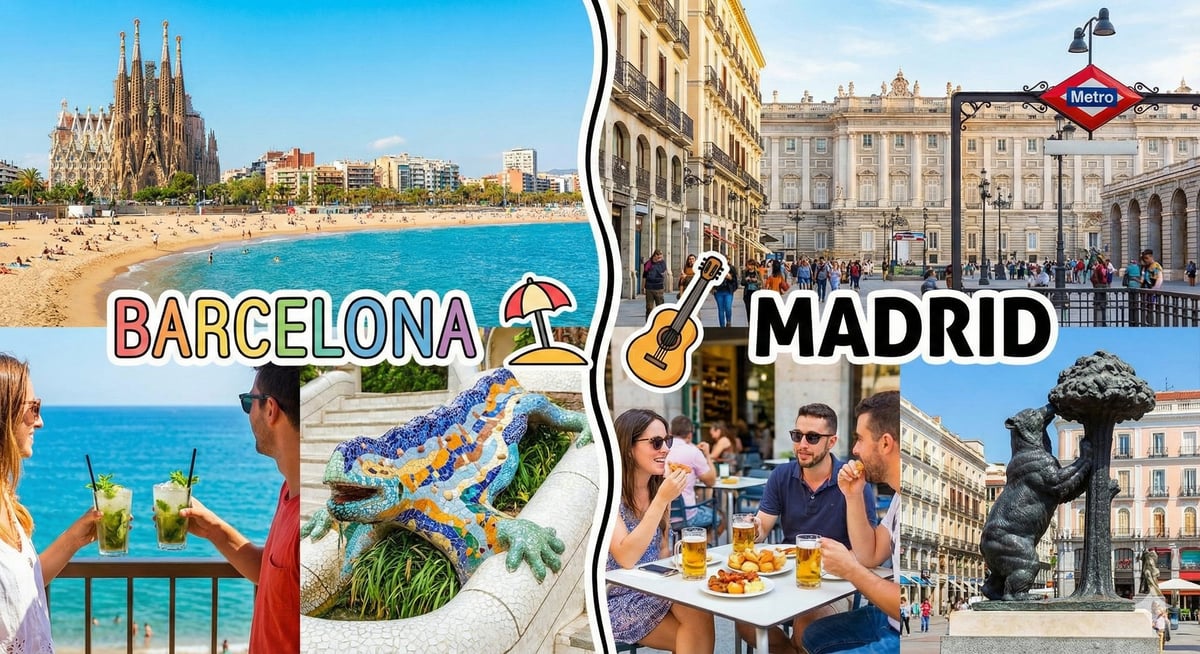
Collage comparing Barcelona and Madrid with landmarks, beaches, and tourist attractions from both Spanish cities

It is Spain's relocation version of El Clásico. Madrid or Barcelona? And if I had a euro for every time somebody asked me which one is "better", I would not be writing this. I would be drinking something expensive on a boat.

The problem is that there isn't actually a winner. There is only: which city suits you better? Because Madrid and Barcelona offer two completely different versions of Spanish city life.

One gives you Mediterranean coastline, Catalan culture and beach-after-work potential. The other gives you huge-city energy, ridiculous connectivity and one of the best social scenes in Spain.

So instead of pretending there is one correct answer, we're putting them in the ring.

Round 1: The Beach

Barcelona: Yes. It has one. Several, actually. And this is a fairly enormous lifestyle advantage if being near the sea matters to you. You can finish work and be sitting beside the Mediterranean shortly afterwards wondering why you ever tolerated commuting home in the rain.

However, Barcelona's most central beaches are urban beaches. Barceloneta is lively, busy and very heavily used. If your dream involves an empty turquoise cove with a solitary beach umbrella and nobody selling you anything, you will probably want to travel further along the Catalan coast.

Madrid: No sea. None. Absolutely bugger all. Madrid Río gives the city plenty of outdoor space and water features, but nobody is confusing it with the Mediterranean. Madrid does, however, have reservoirs, pools and mountain escapes around the wider region. But if your non-negotiable is "I want to walk to the beach", this fight is over.

Winner: Barcelona

Round 2: City personality

Barcelona: Barcelona immediately announces itself. Gaudí. Sagrada Família. Eixample. Gothic streets. Palm trees. Sea. Mountains in the background. It is visually dramatic and very international. The city feels unmistakably Mediterranean.

Madrid: Madrid works differently. It doesn't have the sea or quite the same instant architectural theatre. What it has is energy. Huge plazas. Beautiful boulevards. Packed neighbourhood bars. Late nights. Museums. Parks. People everywhere. Madrid feels like a capital that actually belongs to the people living there rather than existing primarily as a tourist destination.

Obviously, millions of tourists visit Madrid too. But its identity feels very much: working Spanish city first.

Winner: Draw — this one is completely about personality.

Round 3: The weather

This can genuinely decide the whole thing.

Barcelona: Barcelona has a Mediterranean climate. Winters tend to be milder than Madrid. Summers are hot. But the catch is: humidity. There is a particular kind of August day in Barcelona when your hair gives up before breakfast. Being beside the sea moderates temperatures, but humidity can make summer feel very sticky.

Madrid: Madrid is inland and at altitude. Which gives it much greater seasonal extremes. Summer can be HOT. Proper oven-door heat. Temperatures above 35°C are completely normal during the hottest periods and heatwaves can push substantially higher. But it is generally much drier than Barcelona. Winter is genuinely winter. Cold nights. Frost. Occasionally snow. But also lots of crisp blue skies.

So ask yourself: do I hate humidity more than I hate cold? That may answer the question.

Winner: Barcelona for milder winters. Madrid for people who would rather bake dry than steam gently.

Round 4: Cost of renting

Now we need to correct the old version. Previously I would have said Madrid gave you slightly better value. Not anymore. Both cities are brutally expensive by Spanish standards.

And according to Idealista's August 2026 asking-rent data, Madrid sits around €23.3/m² per month, while Barcelona is around €20.2/m² per month — which currently puts Madrid above Barcelona on asking rents. Earlier in 2026 the two were much closer, and Barcelona was around €23/m² while Madrid reached €23.7/m² in June, so these markets can move significantly even within a few months.

The important message is: neither city is cheap. You may also face strong competition, deposits, proof-of-income requirements, guarantor requirements in some cases, landlords choosing between multiple applicants, and very different prices by neighbourhood.

If affordability is your priority, there are considerably easier Spanish cities.

Winner: currently Barcelona on average asking rent, but neither deserves a medal.

Round 5: Finding somewhere to live

This deserves its own round because average prices don't tell you how annoying the actual search can be.

Barcelona: Barcelona's housing market has been under enormous pressure. Supply can be tight and desirable neighbourhoods attract huge demand from locals, international workers, students, professionals and people relocating from elsewhere in Spain. You may also encounter significant differences between ordinary long-term rentals and other temporary or seasonal contracts.

Madrid: Madrid also has extremely high demand. And with current rents among the highest in the country, finding a desirable property at a sensible price is not exactly a relaxing afternoon activity. The advantage of Madrid is sheer scale. There are a lot more neighbourhoods and a huge metropolitan area, so your search radius can expand considerably. But you need to understand transport before deciding "it's only a bit outside the centre." A bit outside Madrid can mean you're practically halfway to another Autonomous Community.

Winner: Neither. Property portals win.

Round 6: Public transport

Both cities actually have excellent public transport. The original version was unfair to Barcelona here.

Madrid: Madrid has an enormous Metro network plus buses, Cercanías suburban trains, regional connections and high-speed rail. It is one of those cities where living without a car is completely realistic for huge numbers of people.

Barcelona: Barcelona also has Metro, buses, trams, Rodalies suburban trains, regional rail and funiculars — and much of the city is very walkable. Barcelona's compact size can actually make daily movement extremely easy.

The biggest difference is scale. Madrid's transport network has to cover an enormous metropolitan area. Barcelona feels more compact.

Winner: Draw — Madrid wins for sheer reach, Barcelona wins for compactness.

Round 7: Getting around Spain

Madrid absolutely shines here. Madrid is essentially sitting in the middle of the country's high-speed rail network. You can reach cities such as Valencia, Málaga, Sevilla, Alicante, Zaragoza and Córdoba remarkably quickly. That makes Madrid an incredible base if you want to explore Spain without flying.

Barcelona has excellent rail links too, particularly towards Girona, France, Zaragoza and Madrid — but Madrid remains the country's natural rail hub.

Winner: Madrid

Round 8: International travel

Both cities have huge international airports.

Barcelona: Barcelona is fantastically positioned for France, Mediterranean Europe, Pyrenees road trips, northern Italy and European city breaks.

Madrid: Madrid-Barajas is one of Europe's major long-haul hubs and is particularly strong for connections to Latin America, North America and major European capitals.

So this depends heavily on where your family, work or travel interests are.

Winner: Draw — your flight route matters more than the city badge.

Round 9: Food

This is where I refuse to choose.

Madrid: Madrid gives you traditional tapas bars, mercados, taverns, brilliant neighbourhood restaurants, enormous international choice, Michelin-starred restaurants and sandwiches containing alarming quantities of calamari. And yes, some bars still serve something to eat with your drink.

But let's kill another internet myth: free tapas is not some universal Madrid law. You'll find it in plenty of places. You will also absolutely buy your own dinner.

Barcelona: Barcelona gives you Catalan cuisine, Mediterranean seafood, incredible markets, international food, serious fine dining and excellent modern restaurant culture. And because it's a major international city, you can find practically anything.

Winner: Everyone with a functioning stomach.

Round 10: Spanish versus Catalan

This is one of the biggest practical differences.

Madrid: Madrid is straightforward linguistically. The principal everyday language is Castilian Spanish. Learn Spanish and you're away.

Barcelona: Barcelona has two official languages: Catalan and Spanish. You can absolutely live in Barcelona speaking Spanish. Millions do. And in international professional circles you may also hear enormous amounts of English. But Catalan matters. You'll encounter it in signs, schools, government, cultural life, local organisations and everyday conversation.

If you plan to settle permanently and integrate deeply into Catalan life, learning some Catalan can be enormously worthwhile. That doesn't mean "nobody will speak Spanish to you." They will. But you're moving to Catalunya. Catalan culture isn't decorative scenery.

Winner: Madrid for linguistic simplicity.

Round 11: Moving with children

This is where language becomes particularly significant.

In Madrid, children entering mainstream education will generally be educated primarily through Spanish, subject to particular bilingual programmes and school arrangements.

In Catalunya, Catalan plays a central role in the education system. That doesn't make Barcelona a bad choice for international families. Far from it. But parents need to understand the schooling system before choosing the city, not discover it after signing a twelve-month rental.

International schools are another option in both places. And both cities have plenty. They also have the invoices to prove it.

Winner: Depends entirely on your family and schooling preference.

Round 12: Making friends

This is where people love making enormous cultural generalisations. "Madrileños are warm." "Catalans are closed." "Barcelona people don't talk to foreigners." Blah blah blah. Cities contain millions of people.

Your experience will depend enormously on neighbourhood, language, work, hobbies, age, whether you actually leave the house and whether you make any effort whatsoever.

That said, both cities have one huge advantage for newcomers: massive populations of people who weren't born there. Madrid attracts people from all over Spain and the world. Barcelona attracts huge international communities alongside people from across Catalunya and elsewhere. You can build a fantastic social life in either. But you do need to build it. Friends do not arrive inside your empadronamiento envelope. If you're moving without a partner or existing network, our guide to moving to Spain alone covers making friends, safety and building a life from scratch.

Winner: Draw

Round 13: Tourism

Barcelona gets enormous visitor pressure concentrated into a relatively compact city. That makes tourism much more visible in everyday life. Certain areas can feel completely overwhelmed during peak periods.

Madrid also receives vast numbers of visitors, but because the city is physically larger and tourism is distributed differently, it can feel less dominant once you move away from the major central attractions.

If you choose Barcelona, neighbourhood becomes particularly important. Living beside La Rambla is not the same experience as living in a quieter residential district.

Winner: Madrid if heavy tourism annoys the hell out of you.

Round 14: Safety

Let's do this without creating nonsense rankings. Both Madrid and Barcelona are major European cities. Both have neighbourhoods that feel very safe. Both have crime.

Barcelona has a particularly well-known problem with pickpocketing and opportunistic theft in heavily touristed areas, which is why visitors are repeatedly warned to watch belongings carefully. Madrid has petty theft too.

So instead of "Madrid safe, Barcelona dangerous", the useful advice is: in either city, don't leave your phone sitting on a café table, watch bags on public transport, be particularly alert in tourist areas, and research the actual neighbourhood you're considering.

For relocation purposes, neighbourhood matters dramatically more than city-level stereotypes.

Winner: Nobody. Keep hold of your bloody phone.

Round 15: Nature

People underestimate Madrid here.

Barcelona: Barcelona gets sea + mountains. Excellent combination. You can access beaches, Costa Brava, Pyrenees, hiking and coastal towns very easily.

Madrid: Madrid doesn't have a coastline, but the Sierra de Guadarrama is right there. You have mountains, hiking, skiing nearby, reservoirs, huge parks and countryside. Madrid city itself also has an enormous amount of green space, including Casa de Campo and Retiro.

Winner: Barcelona if sea matters. Draw if it doesn't.

Round 16: Nightlife

If you want nightlife, congratulations. You've somehow managed to select two Spanish cities with absolutely no shortage of it.

Madrid: Madrid has the reputation for going out late, then deciding apparently that sleep was a mistake anyway. Neighbourhoods such as Malasaña, Chueca, La Latina and Lavapiés offer completely different scenes.

Barcelona: Barcelona adds beachfront clubs, international nightlife, late bars, music scenes and neighbourhood nightlife. Again, completely different depending where you live.

Winner: Your liver loses either way.

Round 17: LGBTQ+ life

Both cities have large LGBTQ+ communities. Madrid's Chueca is internationally famous and Madrid Pride is one of the world's major Pride events. Barcelona also has a large LGBTQ+ scene, with areas such as the Gaixample around Eixample. If this matters strongly to your relocation, both cities deserve serious consideration. For a deeper look at which places offer the community, legal protections and everyday lifestyle you're after, see our guide to moving to Spain as LGBTQ+.

Winner: Draw

Round 18: The tap water

Obviously this requires a round. Because apparently we have reached that stage of relocation research.

Madrid: Madrid residents are famously evangelical about their tap water. The region's water largely comes from mountain and reservoir sources managed by Canal de Isabel II. Ask a Madrileño about the water and prepare yourself. You have triggered a presentation.

Barcelona: Barcelona's tap water meets drinking-water standards, but taste can vary because of mineral content and the water sources supplying the metropolitan area. A lot of residents use filters because they prefer the taste.

This is not "Madrid has drinkable water and Barcelona has toxic swimming-pool juice." Both supplies are potable. One just has a considerably better PR department.

Winner: Madrid — the Madrileños would riot if I said otherwise.

So, should you move to Barcelona?

Barcelona probably suits you if you want: Mediterranean lifestyle, beach access, a compact city, international community, architecture and visual beauty, milder winters, easy access to France and the Pyrenees, and Catalan culture.

And you're comfortable with: tourism, Catalan being part of everyday life, expensive housing, and humid summers.

Should you move to Madrid?

Madrid probably suits you if you want: enormous capital-city energy, fantastic transport, easy travel around Spain, a very strong Spanish-language environment, huge cultural life, nightlife, museums, four genuine seasons, and a city that feels very Spanish despite being internationally connected.

And you're comfortable with: no beach, very hot summers, cold winters, and extremely expensive housing.

Madrid vs Barcelona: the actual verdict

So who wins? Neither. Because choosing where to live isn't Eurovision.

The right question isn't "which is the better city?" It's "which city supports the life I actually want?"

If your fantasy is finishing work and walking down to the Mediterranean, Madrid is never going to win. If you want to spend weekends jumping onto high-speed trains and exploring the whole of Spain, Madrid starts looking incredibly attractive. If you're raising children, language and schooling may decide it. If you're working remotely, the neighbourhood and housing budget may decide it.

If you hate humidity with every fibre of your being: Madrid. If the thought of living 350 kilometres from the sea makes you inexplicably sad: Barcelona. And if you're torn between several different areas beyond just these two, my Area Analysis researches the locations that genuinely match your lifestyle and non-negotiables.

And if you're still stuck? Try my favourite test. Flip a coin. Madrid on one side. Barcelona on the other. Then don't pay attention to where it lands. Pay attention to whether you feel pleased or disappointed. There's your answer.

Still Have No Bloody Idea Where in Spain You Should Live?

Madrid versus Barcelona is actually the easy version. My clients are more commonly sitting there thinking: Madrid? Barcelona? Valencia? Málaga? Alicante? Murcia? Northern Spain? Somewhere I've never even heard of?

And that's exactly why I created my Area Analysis service. You tell me what your actual life needs — budget, climate, coast or city, healthcare, transport, airport access, children and schools, pets, social life, walkability, property requirements, work, and the things you absolutely refuse to compromise on — and I research the locations that genuinely fit. Because choosing an area based on "Barcelona looks lovely on Instagram" is not a relocation strategy.

Explore my Area Analysis service

Important

Housing prices and rental-market conditions change constantly, and neighbourhoods within both cities differ enormously. Current rent figures in this article are indicative asking-price averages rather than guaranteed rents for individual properties.

Natasha Horner

Natasha

Relocation coach helping women move to Spain with clarity and confidence.

Keep Reading

More real talk and practical advice from The Clarity Library.

Browse All Articles