
Retirement

Retiring in Spain in 2026: Visas, Healthcare, Tax and the Reality Nobody Talks About

Natasha Horner

Natasha

15 January 2026 · 18 min read

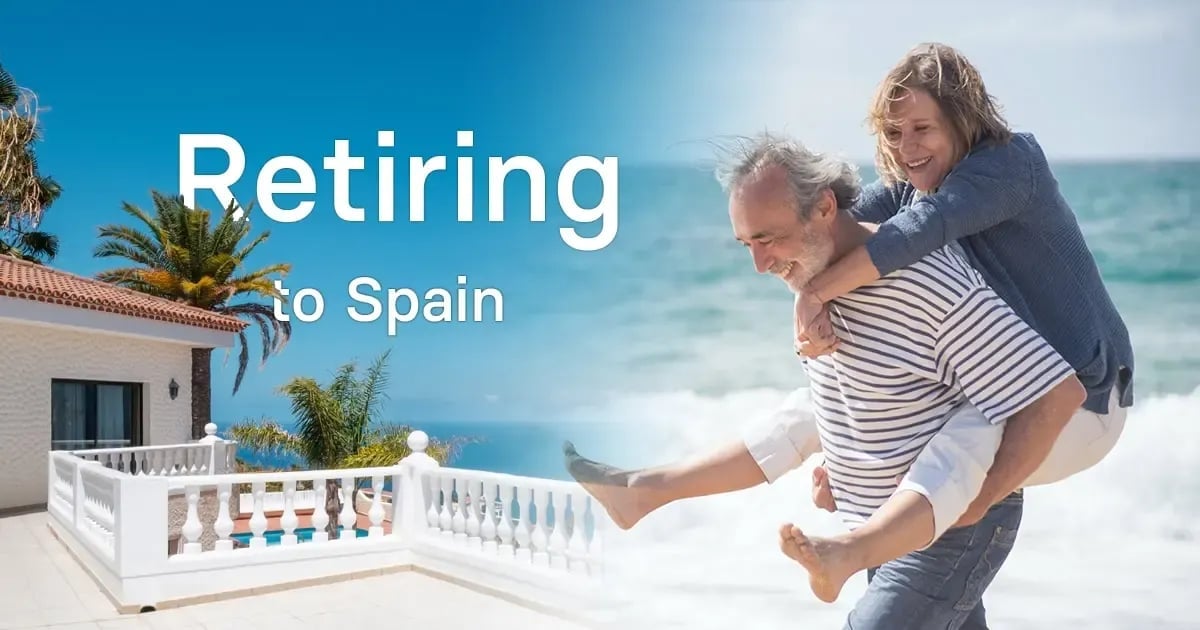
Retired couple playing on beach in front of Mediterranean villa with text Retiring to Spain

Retiring in Spain sounds fairly magnificent.

Sunshine. Long lunches. A terrace. No commute. Coffee that doesn't cost the equivalent of a small mortgage. And finally being able to announce:

"I have absolutely nothing I have to do today."

Which is wonderful. For approximately three weeks.

Because successfully retiring in Spain involves rather more than finding a nice apartment near the Mediterranean and locating your nearest wine aisle.

Before the terrace comes: residency, healthcare, pensions, tax, money, property, location, paperwork.

And after you've sorted all of that comes the question nobody spends quite enough time thinking about:

What is your actual life in Spain going to look like?

Because retirement isn't a permanent holiday. Let's deal with both bits.

Can foreigners retire in Spain?

Yes. But how you legally retire in Spain depends on your nationality and circumstances. There isn't one universal "retirement visa".

EU, EEA and Swiss citizens

Citizens of the EU, EEA and Switzerland have freedom-of-movement rights in Spain. If you're staying for more than three months and are not working, you generally need to demonstrate sufficient financial resources for yourself and relevant family members, and comprehensive healthcare cover in Spain. You also need to register as a resident in Spain within the applicable period.

Non-EU citizens

If you're from outside the EU/EEA/Switzerland, you'll generally need a Spanish immigration route allowing you to reside here. For financially independent retirees who don't intend to work, one of the most common routes is the Non-Lucrative Visa — NLV.

So when you see people talking about the "Spanish retirement visa", they often mean the NLV. But technically there isn't a visa with that official name.

The Non-Lucrative Visa for retirement in Spain

The Non-Lucrative Visa is designed for people who can support themselves financially without working. That makes it particularly suitable for retirees with income or resources such as pensions, investments, rental income, dividends, savings, or other established financial means.

For 2026, the minimum financial requirement for the main NLV applicant is:

€2,400 per month or €28,800 for the first year.

Each qualifying accompanying family member adds €600 per month or €7,200 per year.

So the basic 2026 calculations are:

Household Minimum Financial Requirement
One applicant €28,800
Applicant + 1 dependent €36,000
Applicant + 2 dependents €43,200

Those are the statutory minimums. They are not an automatic approval button. The consulate will still consider whether your evidence properly demonstrates that you can support yourself while living in Spain without working.

And that last bit is important: the NLV does not allow you to work.

So if your retirement actually means "I'm retiring from the office, but I'll keep consulting online three days a week", you need to investigate whether another immigration route fits better.

Healthcare when retiring in Spain

Healthcare needs to be part of your relocation planning before you move. But there isn't one healthcare route for every retiree.

Your entitlement can depend on nationality, previous social-security contributions, pension arrangements, EU healthcare coordination, bilateral agreements, Spanish residency status, and the particular visa you're using.

Some retirees will have access to Spanish public healthcare through existing entitlement. Others will need private healthcare insurance. And some people's healthcare arrangements change after they've lived in Spain for a period of time.

The important thing is: don't assume that obtaining Spanish residency automatically gives you healthcare. Find out what applies to you first.

Private health insurance for retirees in Spain

For many non-EU retirees applying through a route such as the Non-Lucrative Visa, qualifying private healthcare insurance is part of the immigration application. The precise requirements can differ according to the route and consulate, but NLV health insurance is generally expected to provide comprehensive cover in Spain and comply with Spanish visa requirements.

That isn't the same thing as ordinary travel insurance. Your annual holiday policy is designed for holidays. It's not automatically Spanish residency insurance simply because you particularly like it. Make sure any insurer knows exactly what residency application the policy is for.

Healthcare for EU retirees

EU, EEA and Swiss citizens may have healthcare rights under European coordination rules, depending on their pension and social-security position. For example, some pensioners receiving a state pension from another participating European country can have healthcare costs covered by that country while residing in Spain using the appropriate European healthcare documentation.

Other retirees may need comprehensive private cover when registering their Spanish residence. Again, this is why nationality and previous employment history matter. There isn't one answer called "Healthcare for expats in Spain". There are different entitlement routes.

A specific note for British pensioners: the S1

British retirees have an additional post-Brexit healthcare arrangement worth understanding. If you're receiving a UK State Pension or certain qualifying UK benefits, you may be entitled to an S1 certificate. For eligible people, the S1 allows the UK to fund their state healthcare in Spain.

It needs to be obtained through the appropriate UK authority and then registered in Spain. This is a valuable route for qualifying British pensioners. But it's a British-specific arrangement, not how retirement healthcare works for everybody moving to Spain.

If you're American, Canadian, Australian, South African or from another non-EU country, your healthcare arrangements will be different.

Can Americans retire in Spain?

Yes. US citizens can retire in Spain provided they qualify for an appropriate Spanish residence route. For non-working retirees, that may often mean the Non-Lucrative Visa.

US citizens need to pay particular attention to tax because US citizens generally continue to have US tax-filing obligations even while resident abroad. Spanish tax residence can therefore create a two-country tax and reporting situation, with the Spain-US tax treaty and applicable foreign-tax-credit rules becoming important. This is absolutely an area for proper cross-border tax advice.

Can Canadians retire in Spain?

Yes. Canadian citizens can also potentially use a residence route such as the NLV if their circumstances fit. Again, Spanish tax residency can affect pensions, investment income, capital gains, rental income, and foreign assets.

Canada and Spain have a double-taxation treaty, but that doesn't mean you can ignore Spanish reporting once you become resident here.

Can Australians retire in Spain?

Yes. Australian retirees are also non-EU nationals and therefore need an appropriate Spanish residency route. Your pension arrangements, investments and healthcare setup need assessing according to both Spanish rules and any relevant international arrangements.

The important point across all these examples is: Spain doesn't care whether your retirement income came from London, Toronto, Sydney or New York. It cares what the income is, where you are tax resident and what the applicable rules say.

Spanish tax when you retire to Spain

This is the subject many retirees leave until approximately five minutes after it's become urgent. Please don't.

If you become Spanish tax resident, Spain generally taxes you on your worldwide income. You can generally become Spanish tax resident if you spend more than 183 days in Spain during a calendar year. But the 183-day test isn't the only factor. Spain can also consider where the main centre or base of your economic activities or interests is located.

So tax residence and immigration residence are related but not identical concepts. You can have Spanish immigration status without that status alone deciding your tax residence.

Will Spain tax my pension?

Potentially. But the real answer is: which pension? From which country?

Pension treatment depends on the type of pension, the country paying it, Spanish domestic tax rules, and the applicable double-taxation treaty. Different rules can apply to state pensions, private pensions, occupational pensions, and government/public-service pensions.

So the sentence "My pension is already taxed back home" doesn't answer the Spanish tax question. Some pensions may be taxable primarily in Spain once you're Spanish tax resident. Others can be treated differently under international treaties. Get advice based on your specific pension, not somebody else's.

Foreign pensions and double taxation

Spain has double-taxation treaties with many countries. Those treaties exist to determine taxing rights and help prevent the same income being fully taxed twice.

But a tax treaty does not mean you simply keep paying tax wherever you've always paid it. The treaty may assign taxing rights differently once you change residence. You may need to declare income in Spain, claim foreign tax credits, change withholding arrangements, and file in more than one country.

"This is why moving countries is exactly the wrong moment to rely on 'My accountant back home said it'll probably be fine.' You need someone who understands the cross-border position."

Savings and investments when you retire in Spain

Retirees often have finances stretching well beyond the monthly pension. You might arrive with bank savings, shares, investment portfolios, mutual funds, bonds, property, rental income, pension funds, or cryptocurrency.

Once you're Spanish tax resident, overseas investments can become relevant to Spanish taxation and reporting. And investment products that received favourable tax treatment in your previous country don't automatically retain that treatment in Spain. A tax-free wrapper at home isn't necessarily tax-free here. Spain is disappointingly uninterested in how lovely your old country's tax rules were.

Capital gains and moving to Spain

If you're planning to sell major investments, a business, shares or property around the time of retirement, get advice before changing tax residence. Timing can materially affect the tax outcome. A transaction completed before becoming Spanish resident may have very different consequences from the same transaction completed afterwards.

This is one of the clearest examples of why good retirement planning shouldn't begin after you've already unpacked.

Foreign-asset reporting

Spanish tax residents with foreign assets can have additional reporting obligations. One well-known example is Modelo 720, which can cover categories including overseas bank accounts, certain foreign investments, and property outside Spain.

Broadly, reporting can arise when assets within a relevant category exceed €50,000, subject to the detailed rules. This isn't itself a tax — it is an information declaration. But it's precisely the kind of thing people discover after moving and say: "Nobody told me about that."

Which is why I'm telling you about it now.

Wealth Tax in Spain

Spain also has Wealth Tax — Impuesto sobre el Patrimonio. Whether it affects you depends on factors including your wealth, debts, assets, residence, your Autonomous Community, and applicable allowances and exemptions.

Under the general state rules, there is a €700,000 personal exemption, unless the relevant Autonomous Community has set different rules. There can also be an exemption of up to €300,000 for a qualifying main residence. Regional differences can be significant.

Spain also has the Solidarity Tax on Large Fortunes, which becomes relevant for sufficiently high levels of net wealth.

If you're moving with a modest pension and ordinary savings, don't panic because you've just read "Wealth Tax". If you're moving with several million euros of assets, however, get advice before becoming Spanish resident.

How much money do you need to retire in Spain?

This is one of the most searched questions. It's also slightly meaningless without knowing where and how you want to live.

A couple retiring in inland Murcia will have a very different budget from somebody wanting a frontline apartment in Marbella. Spain can still offer excellent value, but the idea that the whole country is incredibly cheap is outdated.

Your retirement budget needs to consider:

  • Rent or mortgage
  • Utilities and community fees
  • Local property taxes
  • Food and transport
  • Healthcare
  • Travel, hobbies and entertainment
  • Maintenance and future care costs

And then there's the most important budget category: your actual lifestyle.

If you're planning to eat out six times a week, play golf, travel constantly and live somewhere expensive, your cost of living isn't going to resemble somebody else's €1,500-a-month retirement blog.

Renting before buying in Spain

For retirees, I particularly like the idea of renting before buying. Not because buying Spanish property is inherently a bad idea, but because committing to a permanent home before you've actually lived in the area is a massive decision.

Renting first lets you discover what winter feels like, how crowded summer gets, whether you actually need a car, how accessible healthcare is, whether you've found a community, and whether that beautiful hillside is quite as charming every time you go shopping.

Your retirement property needs to work as a home, not just look fabulous on Rightmove, Zillow or Idealista.

Best places to retire in Spain

There is no universal answer. And I refuse to tell you that Alicante is the "number one best place to retire in Spain" simply because Google likes numbered lists.

Where you should retire depends on your budget, preferred climate, healthcare requirements, airport access, transport, language, family connections, community, hobbies, property preferences, whether you drive, and how you envisage later life. Those things matter far more than another internet ranking.

Costa del Sol

Popular with retirees from across the world because of Málaga Airport, climate, beaches, private healthcare, international communities, restaurants, golf, and established services. Places including Málaga, Fuengirola, Mijas, Benalmádena, Marbella and Estepona all appeal to international retirees. But they're not interchangeable, and some parts of the Costa del Sol have become considerably more expensive.

Costa Blanca and Alicante

Another major retirement destination, particularly around Alicante. Attractions include a warm climate, established international population, airport access, coastline, healthcare, and a range of property markets. Again, one town can feel completely different from another 20 minutes away.

Valencia

Valencia attracts retirees who want more of a city lifestyle while retaining beach access, parks, culture, public transport, healthcare and restaurants. It can be particularly attractive for people who don't want their retirement to revolve around driving everywhere.

Murcia

Often worth considering if your priorities include warmer weather, more space, potentially lower housing costs, and quieter communities. It's a different proposition from the major international coastal resorts. For some people, that's exactly the point.

Andalucía beyond the Costa del Sol

Don't assume Andalucía begins and ends at Marbella. There are inland towns, villages, smaller coastal communities, and cities such as Granada, Sevilla and Córdoba that can offer very different lifestyles. Property can also be considerably cheaper away from the most international coastal locations.

But transport, extreme summer temperatures and access to healthcare may become more important considerations depending on where you choose.

Northern Spain

People often forget half the country exists. Northern Spain can be fantastic if you don't actually want relentless heat. Regions such as Galicia, Asturias, Cantabria and the Basque Country offer greener landscapes, cooler climates and completely different lifestyles.

Spain is not one giant Costa del Sol. That's why deciding "I want to retire in Spain" is only the beginning.

Think about healthcare when choosing where to live

The cute village may be perfect today. But ask: where's the nearest hospital? Where's the health centre? Are there specialists nearby? Can I reach them without driving?

These questions become more important with age. Your retirement location needs to work for future-you as well as current-you.

Think about transport

One of my favourite retirement questions is: what happens when you stop driving? Not "will I stop driving?" — eventually, most of us will.

If your entire Spanish life depends on a car, think carefully about buses, trains, taxis, walkability, shops, doctors, pharmacies and social activities. The isolated finca might cost half as much as an apartment in town. There may be a reason.

Future-proof the property

Property features that seem irrelevant at 60 can become extremely relevant later. Think about steps, lifts, steep streets, bathrooms, maintenance, gardens, swimming pools, access, parking, and shops within walking distance.

You don't need to buy a retirement home that resembles a medical facility. Just think beyond the next five years.

Retirement is not a permanent holiday

And now we get to the part nobody puts in the brochure.

You've spent decades imagining: "When I retire, I'm doing absolutely nothing." Then you retire. Turns out absolutely nothing gets quite boring by Thursday.

Spain can give you sun, beaches, mountains, cafés, restaurants and a beautiful home. But Spain cannot automatically give you purpose. You have to build that bit yourself.

What do retired people actually do in Spain?

Anything they bloody like. But retirees who thrive tend to build some kind of routine and community. That might mean:

  • Walking groups, hiking, cycling
  • Golf, padel, swimming
  • Art, language classes, book clubs
  • Gardening, volunteering, charity work
  • Animal rescue, local clubs, cultural groups, community associations

The activity itself matters less than having somewhere to go and people who know you're coming.

Volunteering after retirement

Retirement doesn't delete decades of experience. Spain has charities, associations and community organisations where retirees contribute through fundraising, administration, mentoring, animal care, events, social media, language practice and organisation.

Feeling useful is wildly underrated. You left your job. You didn't cease to have skills.

Learn some Spanish

If you're retiring permanently in Spain, learn some Spanish. You don't need to become Cervantes. Nobody expects a flawless subjunctive while you're ordering tomatoes.

But language gives you independence, confidence, better communication with doctors, conversations with neighbours, access to local life, and fewer situations where you smile enthusiastically despite having absolutely no idea what's happening.

If you move to a region with another co-official language, learning some local language can also help you connect with the community. Effort matters.

Loneliness after retiring abroad

This is something worth discussing honestly. Retirement already removes colleagues, routine, professional identity and daily interaction. Moving country simultaneously removes familiar neighbours, old friends nearby, family routines, familiar shops and established support networks.

That's a lot of change. You can absolutely adore Spain and still occasionally feel lonely. That's not evidence the move failed. It's evidence you moved your entire life to another country. Build social connection deliberately.

How close will you be to family?

For many retirees, the biggest downside of moving abroad is distance from children, grandchildren or ageing relatives. Before relocating, think realistically about flight connections, airport distance, flight prices, how often you'll travel, who will visit you, and what happens during emergencies.

A beautiful town three hours from an international airport may be absolutely fine. Until you want to make that journey eight times a year.

What happens if one partner dies or becomes ill?

Nobody enjoys this section. Still important.

If you're retiring as a couple, ask: could either one of us manage this Spanish life alone? Think about language, finances, driving, property, healthcare, friends, legal arrangements, wills and support networks.

A retirement plan that's completely dependent on one partner doing all the Spanish, driving and administration has a vulnerability built into it. Plan together, but make sure both of you can function independently too.

What order should you plan retirement in Spain?

I would broadly do it like this:

  1. 1 Residency — understand the legal route applying to your nationality and circumstances.
  2. 2 Tax and financial planning — find out what Spain would do with your pensions, investments, property, foreign assets and estate.
  3. 3 Healthcare — establish exactly how you will be covered.
  4. 4 Budget — calculate your real Spanish lifestyle.
  5. 5 Location — identify areas that match your everyday requirements.
  6. 6 Housing — rent or buy after understanding the location properly.
  7. 7 Community and lifestyle — think about how you're actually going to live once you arrive.

Notice that "Buy beautiful Spanish villa" is not number one. There's a reason.

The honest takeaway

Retiring in Spain can be extraordinary. But the successful version isn't "sun + house + pension = happily ever after".

It's the correct residency, healthcare that actually works for your situation, understanding what Spain will do with your money, a realistic budget, a location that suits your life now and later, and a reason to get out of bed other than checking whether the sun is still shining.

Do the boring thinking first. Then you get to enjoy the terrace.

Thinking About Retiring in Spain?

Retirement relocation is rarely just a visa question. Your nationality, residency route, healthcare, pensions, tax, property and location choices all connect, and making one decision without understanding the others can become expensive.

My Clarity & Strategy Session helps you map out the move, identify what needs investigating and put things in the right order before you start committing money.

And if the question keeping you stuck is "Where in Spain should I actually retire?", my Area Analysis service looks at your real requirements — healthcare, transport, climate, housing, budget, airports, community and lifestyle — and identifies locations that make sense for you.

Where regulated tax, immigration, financial or legal advice is required, I'll direct you towards the appropriate qualified professional.

The aim isn't simply to retire in Spain. It's to build a retirement in Spain that still works ten, twenty or thirty years from now.

Book a Clarity Call

Important

This article provides general relocation information only and is not personalised immigration, tax, financial, healthcare or legal advice. Residency and healthcare rights depend on nationality and individual circumstances, while pension and tax treatment can differ according to the relevant international agreements. Always verify current requirements and seek appropriate professional advice before relocating.

Natasha Horner

Natasha

Relocation coach helping women move to Spain with clarity and confidence.

Keep Reading

More real talk and practical advice from The Clarity Library.

Browse All Articles