Family Life

Moving to Spain With Children: Schools, Healthcare, Costs and the Reality of Family Life in Spain

Natasha Horner

Natasha Horner

Family Life · 15 min read

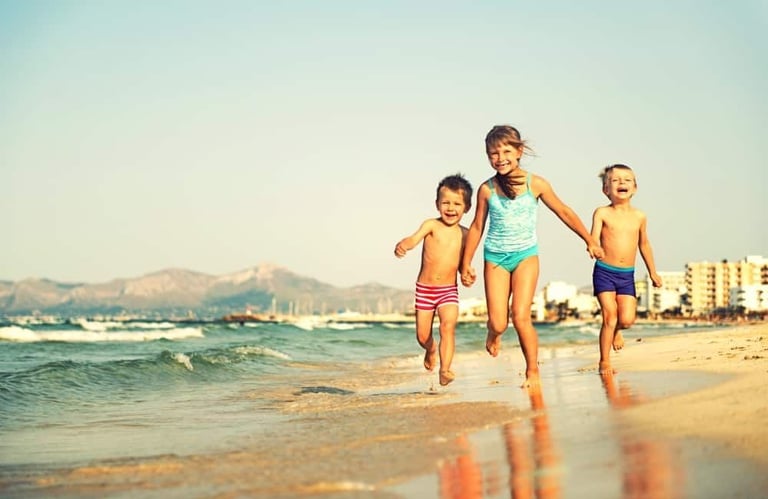
Three young children running together on a sunny beach with mountains and buildings visible in the background

Let's be honest from the start.

Moving to another country is a big decision.

Moving to another country with children is an entirely different sport — usually played while tired, emotional and carrying a backpack containing passports, birth certificates and seventeen documents somebody has suddenly decided need an apostille.

And yes, moving to Spain with children can be bloody brilliant.

You can get:

  • more outdoor living
  • warmer weather
  • a very family-orientated culture
  • children actually being welcome in restaurants
  • beaches, parks and plazas becoming part of normal life
  • and, depending on where you're coming from, potentially a very different pace of family life

But parents don't usually worry about any of that at 3am.

They worry about:

Will they settle?

What school should I choose?

What if they don't speak Spanish?

Will they make friends?

Can I afford international school?

And have I just completely ruined their lives?

That last one is particularly popular.

So let's deal with the reality rather than the Instagram version.

Is Spain a good place to raise children?

For many families, yes.

One of the biggest differences people notice after moving to Spain is how naturally children fit into everyday life.

Spain is generally a very family-orientated country. Children aren't expected to disappear from public life at 6pm.

You'll see families:

  • eating together in restaurants
  • meeting in plazas
  • spending evenings outdoors
  • attending local fiestas
  • sitting in cafés
  • using parks and beaches late into the day

Nobody is clutching their pearls because an eight-year-old is eating dinner at 9pm. That's just life.

Obviously, raising a family in Madrid is very different from living in a small Andalusian pueblo, and life on the Costa del Sol isn't the same as rural Galicia.

But culturally, children tend to be very visible and included. For many families moving from the UK, northern Europe or North America, that feels refreshing.


Before you move: choose the school AND the location together

This is probably the biggest piece of advice I can give families.

Do not choose an area first and start thinking about schools afterwards.

Your school decision and your location decision need to happen together.

Because a beautiful villa 35 minutes away from the school might look fabulous on Idealista. It becomes considerably less fabulous when you're doing that journey:

twice in the morning + twice in the afternoon + activities + traffic + five days a week.

And if your children are going into the Spanish public system, where you live can also affect which schools are realistically available to you because admissions to publicly funded schools are administered by the Autonomous Communities and local catchment/admission criteria can apply.

So when choosing an area, investigate:

  • school options
  • availability
  • admissions periods
  • transport
  • commute times
  • school buses
  • after-school activities
  • language of instruction
  • how long you realistically expect to stay in Spain

before signing a long-term rental or buying property.

How does the school system in Spain work?

Spain has three main types of school ownership:

Public schools — Colegios Públicos

Public schools are state-funded. Compulsory education is free, although families can still have costs such as:

  • materials
  • books in some regions/circumstances
  • uniforms where applicable
  • school meals
  • transport
  • extracurricular activities

Public schools follow the Spanish curriculum, alongside the curriculum and language arrangements of the relevant Autonomous Community.

That last bit matters. Because Spanish is not necessarily the only classroom language everywhere in Spain.

Depending on the region, children may also be educated partly or substantially in languages such as: Catalan, Valencian, Basque, Galician.

So don't simply ask: "Does my child need to learn Spanish?"

Ask: "What language or languages will my child actually be taught in where we're planning to live?"

Huge difference.

Concertado schools

Concertados are privately owned schools that receive public funding for certain stages of education. Think of them as sitting somewhere between public and fully private schooling.

They can be:

  • religious or secular
  • academically strong
  • popular with local families
  • oversubscribed in certain areas

The publicly funded education itself is subject to the concertado system, although families may still encounter charges for things outside the funded teaching, such as meals, activities, uniforms or additional services.

Admissions to public and concertado schools are governed by the relevant regional education authority. So again: don't assume you can simply pick any concertado and walk in.

Private schools

Private schools are independently funded through fees. They may follow:

  • the Spanish curriculum
  • a bilingual model
  • British curriculum
  • International Baccalaureate
  • American curriculum
  • French curriculum
  • German curriculum
  • or another recognised educational system

International schools

When people talk about "international schools", they're generally talking about private schools offering an international or foreign curriculum, rather than a separate fourth legal category of school.

These are especially popular with families who:

  • have older children
  • may return to another country later
  • have children approaching major examinations
  • want English-language education
  • move frequently for work

And yes. They can be expensive. Very expensive.

What age is school compulsory in Spain?

Compulsory education in Spain runs generally from age 6 to 16.

Children ordinarily attend:

Educación Primaria

Ages approximately 6–12. Six academic years.

Educación Secundaria Obligatoria — ESO

Ages approximately 12–16. Four academic years.

Both stages are compulsory and free within the public education system.

Before age six, children may attend Educación Infantil, but this stage is not compulsory.

After ESO, young people may continue into routes such as: Bachillerato, vocational education (Formación Profesional), or other educational pathways.

This becomes particularly important if you're moving with a teenager, because transferring educational systems at 14 or 15 requires much more consideration than moving with a four-year-old.

Should my child go to a Spanish school or an international school?

There is no universal answer. I wish there were, because it would make my job significantly easier.

For a younger child who is moving permanently to Spain, Spanish schooling can offer enormous benefits:

  • language immersion
  • local friendships
  • integration
  • connection to the community
  • much faster Spanish acquisition

For an older child who is halfway through GCSEs, A-levels, IB or another qualification system, suddenly throwing them into a completely different educational system and language can be a very different proposition.

You need to consider:

  • age
  • personality
  • existing language ability
  • additional learning needs
  • exams
  • how permanent the move is
  • future university plans
  • where they may live later

The "best school" is the one that works for that child and that family's plans. Not the one somebody declared "the best international school on the Costa del Sol" in a Facebook comment.

What happens if my child doesn't speak Spanish?

This is probably one of parents' biggest fears.

And yes, moving a child into a school where they don't understand the language can be hard.

I won't give you the fluffy: "Don't worry, children are little sponges!" and pretend there's never an adjustment period.

Some children adapt incredibly quickly. Others need much more support. Age matters. Confidence matters. Personality matters. Previous language experience matters. The school matters.

Younger children often acquire language naturally through: play, lessons, sport, friendships, clubs, daily interaction.

Older children can find the academic language much more difficult because they're simultaneously trying to understand subjects such as science and history while learning the language those subjects are being taught in.

Schools can provide support for pupils arriving from foreign education systems, but the arrangements differ regionally and between schools.

So ask the individual school:

  • What support exists for children who don't speak Spanish?
  • How many international children do you currently have?
  • What happens during the first few months?
  • Is additional language support available?
  • How will subjects be assessed initially?

Those answers tell you far more than the school website.

Moving to Spain with a teenager

This deserves its own section because moving with a teenager is not the same as moving with a seven-year-old.

A teenager may be leaving behind: GCSE courses, A-level plans, established friendships, sport, relationships, social identity, university pathways.

And they might not be thrilled that Mum and Dad have decided sunshine is more important than the fact their entire life currently exists in Birmingham. Fair enough.

For older children, investigate education before deciding your move date.

You may discover that moving: six months earlier, one academic year later, after GCSEs, or before a particular examination cycle — makes the transition dramatically easier.

Sometimes the right relocation plan involves waiting. That isn't failure. That's planning.

School admissions in Spain

This varies considerably across Spain because education is administered by the Autonomous Communities.

Public and concertado admissions can take account of regional criteria such as:

  • where the family lives
  • siblings already attending
  • family circumstances
  • available places
  • other priorities established by the regional authority

There are annual admissions periods, but families arriving during the school year can still need places and should contact the relevant education authority or local school-placement service.

This is why your padrón — municipal registration — can become important. Your address may affect school allocation or admissions scoring, depending on the region.

Do not wait until August and casually announce: "Right, we need three school places for Monday."

Possible? Sometimes. Good relocation strategy? Absolutely not.

What paperwork do children need when moving to Spain?

This depends heavily on: nationality, whether you're EU or non-EU, your residency route, the child's relationship to the applicant, the region, and school requirements.

Documents you may potentially need include:

  • passports
  • visas/residence documentation
  • NIE numbers
  • TIEs where applicable
  • birth certificates
  • marriage/custody documents
  • school reports
  • academic records
  • vaccination records
  • proof of address
  • padrón certificate
  • photographs
  • translated documents
  • apostilled/legalised documents where required

And if parents are separated, divorced or one parent isn't moving to Spain, custody and parental consent can become a very important legal issue.

Do not assume one parent can simply relocate a child internationally because they have the child's passport. If parental responsibility is shared, get proper family-law advice before making plans. That one can become serious very quickly.

Do children need an NIE in Spain?

Foreign nationals who have dealings with Spanish authorities can be assigned an NIE — Número de Identidad de Extranjero. It is the foreigner's identification number used across Spanish administrative processes.

Children residing in Spain under the relevant immigration arrangements can therefore also have NIE numbers.

But remember: the NIE is a number, not residency itself. People constantly confuse the two. Your child's actual immigration/residency route depends on nationality and family circumstances.

Healthcare for children in Spain

Spain has an excellent healthcare system, but access is more nuanced than: "Move here, register, done."

How your family accesses healthcare can depend on:

  • whether a parent works in Spain
  • Spanish Social Security entitlement
  • EU coordination rules
  • residency status
  • reciprocal arrangements
  • your visa
  • private insurance requirements

Some residence routes require families to have private medical insurance as part of the immigration application. Others may lead to entitlement through the Spanish Social Security system.

Once properly entitled and registered within the appropriate regional healthcare service, children can access services such as: paediatric care, vaccinations, primary care, referrals, emergency treatment.

Healthcare itself is one of Spain's major strengths. But make sure you understand how your family qualifies for it rather than assuming the visa and healthcare systems are the same thing. They aren't.

Cost of moving to Spain with children

Can Spain be cheaper than the UK, US or northern Europe? Absolutely. Can Spain also be bloody expensive? Absolutely.

Your costs will depend enormously on where and how you choose to live.

Typical family costs to investigate include:

  • rent or mortgage
  • private/international school fees
  • school meals
  • school transport
  • uniforms
  • childcare
  • private health insurance where required
  • car costs
  • utilities
  • activities
  • food
  • travel back home

A family sending two children to international school on the Costa del Sol has an entirely different budget from a family using a local public school in inland Andalucía.

This is why "Is Spain cheaper?" is the wrong question. The right question is: "What would our family's life cost in the specific place we're considering?"

Best places to live in Spain with children

I'm going to disappoint Google slightly here. There is no single best place in Spain for families, because families want completely different things.

One family wants: international school, beach, airport within 20 minutes, English-speaking community, sports clubs.

Another wants: Spanish immersion, countryside, affordable housing, local community, zero tourists.

Those families should not be moving to the same place.

But some areas repeatedly come up in family relocation conversations.

Costa del Sol

Popular with international families because of: international and bilingual schools, Málaga Airport, established expat communities, beaches, sports, year-round outdoor life.

Areas such as Málaga, Mijas, Fuengirola, Benalmádena, Marbella and Estepona can all work for families — but they offer very different lifestyles and housing costs. And the Costa del Sol is no longer the bargain destination people sometimes imagine it is.

Costa Blanca and Alicante

Popular for: international communities, good transport connections, beaches, family lifestyle, broad choice of towns and residential areas. Costs can vary significantly depending on exactly where you choose.

Valencia

A very strong option for families wanting an actual city without Madrid or Barcelona scale. It offers: beaches, parks, public transport, culture, schools, cycling, family neighbourhoods.

But remember that Valencian can be part of the education system, depending on school and location.

Murcia

Often considered by families looking for: more space, potentially lower housing costs, warmer weather, less international-tourist intensity. It won't suit everyone, particularly if international schooling or major-airport connectivity is the top priority.

Madrid

Not the obvious "move to Spain for beach life" choice, admittedly. But for families prioritising: career opportunities, schools, transport, culture, international connections — Madrid can make a lot of sense.

Barcelona and Cataluña

Barcelona and surrounding areas offer: international schools, culture, beaches, transport, employment opportunities.

But housing can be expensive, and families considering local schooling need to understand the role Catalan plays within the education system.

Again: location and schooling must be researched together.

Don't choose a Spanish town because somebody else loves it

This is probably my biggest relocation bugbear.

Someone tells you: "Jávea is amazing for families." Great. Maybe it is for their family.

What if you need: an international secondary school, a train station, specialist medical care, work in Málaga, no car, airport access, a football academy? Suddenly the recommendation isn't particularly useful.

Where you live determines:

  • school
  • commute
  • housing costs
  • social life
  • language exposure
  • transport
  • your children's independence
  • your own sanity

Choose based on your actual life, not somebody else's holiday.

Will my children actually settle in Spain?

Probably. But let's not pretend every child skips through the airport clutching a Spanish flag and immediately develops seventeen bilingual best friends.

There can be: homesickness, frustration, language problems, loneliness, anger, culture shock, missing grandparents, missing friends, wanting to go home.

And children can look completely fine for the first few weeks and then suddenly struggle. That's normal adjustment. Parents often have their own version too.

The strange thing is that sometimes the child you were most worried about thrives immediately. Meanwhile you're sitting in a school WhatsApp group translating 94 messages about somebody needing to bring cartulina azul tomorrow and wondering what the hell happened to your life.

Give everyone time.

Help your children build a life, not just attend school

School matters enormously. But integration doesn't stop at the school gates. Sport, activities and community can often make the biggest difference.

Think:

  • football
  • swimming
  • dance
  • martial arts
  • music
  • scouts
  • local clubs
  • language exchanges
  • summer camps

Children make connections by doing things repeatedly with the same people. And that applies to adults too, actually. Moving to Spain becomes much easier when the family starts building a real life rather than simply living in a Spanish property.

What should you sort out first when moving to Spain with children?

If I were planning a family relocation, my order would broadly be:

1. Residency route

Can the whole family legally move to Spain and under what status?

2. Tax and finances

What happens financially once you become Spanish residents?

3. Area shortlist

Where genuinely works for your budget and lifestyle?

4. Schools

Which schools fit each child and are places realistically available?

5. Housing

Now choose a property based around the life you've just planned. Not the other way around.

6. Healthcare

Understand how everyone will be covered from arrival onwards.

7. Documentation

Birth certificates, consent documentation, school records, apostilles, translations and everything else required.

8. The actual transition

Move dates, school starts, activities and how you're going to help everyone settle.

This saves you from doing what many families accidentally do: fall in love with a house and then try to build their entire relocation around it.

The honest takeaway

Moving to Spain with children can genuinely be life-changing. It can give families:

  • more time outdoors
  • a different pace
  • new languages
  • international experiences
  • new friendships
  • stronger family time
  • an entirely different childhood

But the move works best when the adults do the boring thinking beforehand. School. Residency. Tax. Money. Healthcare. Location. Transport. Documents.

Then you get to enjoy the lovely bit.

Spain can be magical for children. You just don't need to make the process unnecessarily unhinged.

Planning a Move to Spain With Children?

Family relocations are exactly where generic advice starts becoming fairly useless. The right town depends on your children, your school preferences, your budget, your residency position, your work, your transport needs and what you actually want everyday life to look like.

My Clarity & Strategy Session helps you work through those moving parts before you start making expensive decisions.

And if you're already struggling with where in Spain your family should actually live, my Area Analysis service goes much deeper into matching locations to your family's real requirements — schools, transport, housing, lifestyle, budget and everything else that matters once the holiday glow wears off.

Where regulated immigration, tax or legal advice is required, I'll also point you towards the appropriate specialist.

Because choosing Spain is the easy part. Choosing the right version of Spain for your family is where the real planning starts.

Important

This guide provides general relocation information and is not immigration, legal, educational, healthcare or tax advice. School admissions, curriculum, healthcare access and administrative requirements differ between Spain's Autonomous Communities and according to individual circumstances. Always check current requirements for the region and residency route relevant to your family.

Natasha Horner

Natasha Horner

Relocation coach helping women move to Spain with clarity and confidence.

Keep Reading

More real talk and practical advice from The Clarity Library.

Browse All Articles